The Disney Effect: Why Some Authors Keep Readers (And Others Lose Them)
Many fiction (and non-fiction) authors believe that once they have written an exceptional book, their job is complete. They pour their heart into a story, hit “publish” and assume that if readers love it, they will automatically return for the next release. But when sales dashboards show that Book One is doing well while Book Two stagnates, the same question always arises: why didn’t those readers come back?
Author coach Rebecca Hamilton often illustrates the answer with an analogy that is as simple as it is powerful.
The Grand Canyon Problem vs. The Disney Experience
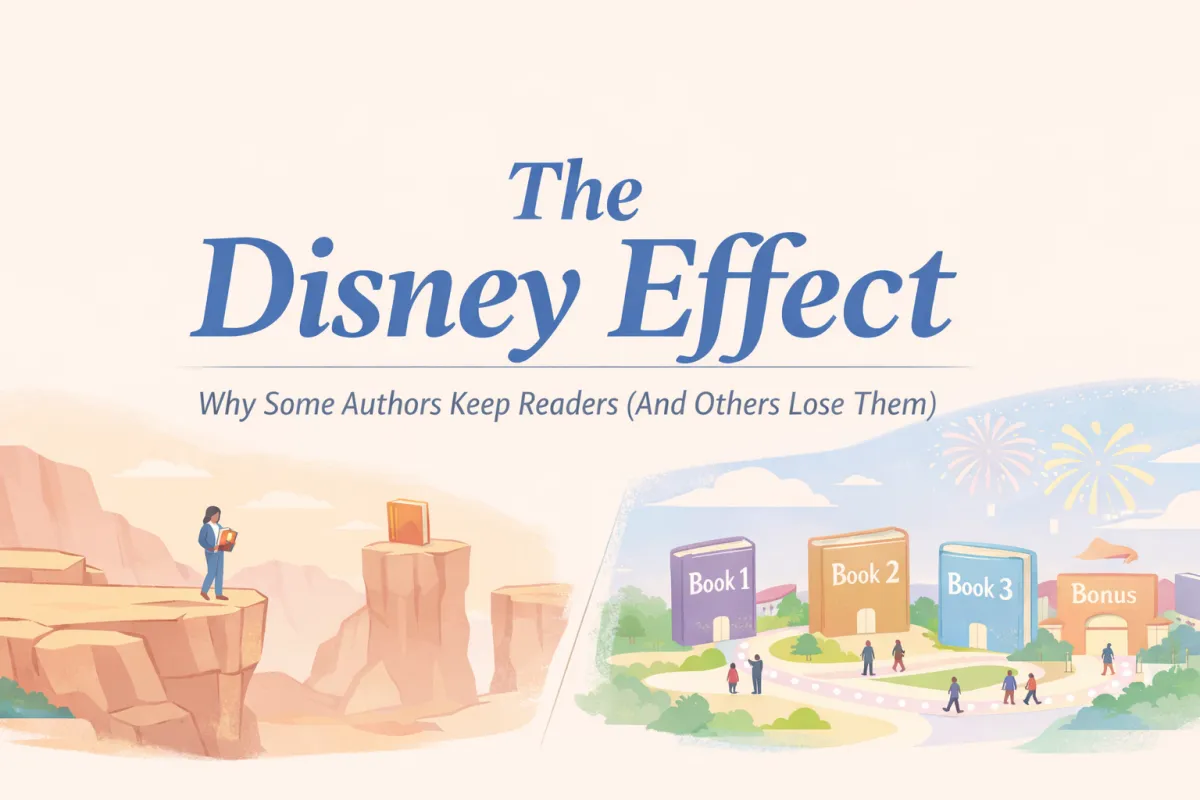
When you visit the Grand Canyon, the experience is breathtaking. You take photos, share them on social media, and tell everyone how incredible it was. But you rarely plan to go back every year. You’ve “done” the Grand Canyon. There’s nothing left to explore.
Now think about Disney. Whether it’s Disneyland or Disney World, the majority of visitors return again and again. They bring friends, family and, later, their own children. They plan future trips before the current one has even ended. The difference isn’t that the Grand Canyon is inferior or that Disney has better weather, it’s that Disney is built as an ecosystem.
Disney offers familiar characters, recognisable branding, emotional continuity and a feeling of belonging. Even when attractions change, visitors feel connected to the world. There’s always more to discover.
The experience is designed to create return visits.
Many authors unknowingly build their catalog like the Grand Canyon. They write a phenomenal story with a clear beginning, middle and end. Readers love it, leave five‑star reviews and feel completely satisfied, and that satisfaction is exactly why they don’t feel compelled to pick up the next book. When a book offers closure with no hint of anticipation, there is no reason to return.

Why Reader Psychology Matters More Than Author Opinion
A common misconception is that quality alone creates loyalty. Authors often think that if their book is objectively better than whatever is topping bestseller lists, it should outsell them. This mindset ignores a core truth: readers, not authors, decide what becomes a bestseller. Rebecca Hamilton emphasises this in her article on why reader taste matters more than author opinion. She notes that authors sometimes dismiss wildly popular books as poorly written, forgetting that millions of readers clearly felt differently. Those readers were emotionally engaged, and emotional engagement is what makes them eager for the next instalment.
When you structure your catalog as a series of complete, isolated experiences, you inadvertently train readers to close the loop. They read, enjoy and then move on to someone else. In Disney terms, you gave them a Grand Canyon.
Ecosystems vs. One‑Offs
Building a reader ecosystem means designing your catalog so that books feed into one another. Instead of standalone satisfaction, you create subtle anticipation. This means you plant seeds for future curiosity. Think of how Disney uses recurring characters and familiar settings to build continuity without sacrificing the completeness of each movie or ride.
Rebecca discusses the importance of systems over tactics in scaling author careers. In her blog she explains why your book ads won’t scale without systems; because ads alone are tactics, whereas a cohesive ecosystem is what allows those tactics to compound over time. If readers finish a book and immediately want to stay in your world, your ads are working with your catalog instead of against it.
Similarly, Rebecca’s article on why so many authors work hard and still don’t scale highlights the danger of working endlessly on tactics without addressing the structural bottleneck in their business. Authors invest in more marketing courses and social media challenges, but if their catalog encourages one‑and‑done reading, no amount of hustle will lead to retention.
Designing for Retention (and Revenue)
Retention it’s about alignment and anticipation. Alignment means you know exactly who your dream reader is and design each book to speak directly to them.
Rebecca breaks down how to ensure marketability through alignment in her post Top 5 Questions to Ensure Marketability.
Anticipation means you think like Disney: leave readers excited to continue exploring the world you created, whether through a sequel, a spin‑off or even a nonfiction guide about your universe.
When you design your catalog this way, retention becomes structural. Sales of later books climb not because you’re shouting louder on social media, but because your catalog is doing the heavy lifting.
That’s why we urge authors to stop following bad book marketing advice and focus on systems that actually work. It’s also why our community emphasises that writing more books isn’t enough, those books need to function together.
From a revenue standpoint, the math is simple. If 1,000 readers buy your first book and only 3% buy the second, you have a retention problem. But if 60–80% of those readers continue into Book Two, Book Three and beyond, your advertising spend drops and your profit margins widen. You no longer need to “find new readers” for every release, because your existing readers are naturally flowing through your catalog.
A Natural Next Step
If you’re ready to move beyond one‑off successes and build a career that compounds, the first step is to understand how launches interact with Amazon’s algorithm and your long‑term ecosystem. Rebecca’s article on book launches and relaunches explains how to trigger Amazon’s algorithm the right way and why timing matters more than most authors realise. She shows how your launch strategy can kick‑start Dream Reader Sequencing, the process by which Amazon and other vendors promote your book for you when the right sales signals come in.
When you treat your catalog like Disney instead of the Grand Canyon, your books stop being one‑time experiences and start becoming part of a world readers never want to leave.
