Why You've Done Everything Right and Your Book Sales Still Don't Reflect It
There is a trap most fiction authors fall into before they ever spend a dollar on ads, hire an editor, or sign up for a coaching program.
It has nothing to do with their writing. It has nothing to do with their genre. And it is not their fault.
The trap is this: assuming that because someone offers a service, that person is the right one to help them.
Author coach Rebecca Hamilton has spent over a decade watching this play out across thousands of author careers, and it is the single most common reason talented, hardworking fiction authors stay stuck far longer than they should.
The Difference Between a Book Marketing Service Provider and a Book Marketing Strategist
The author support industry is full of talented people. Cover designers, editors, formatters, social media managers, ad runners, launch coordinators. These are service providers, and they are genuinely valuable.
But a service provider and a strategist are not the same thing.
A service provider executes a task. A strategist understands why that task matters, when it matters, how it fits into everything else, and what happens to your career if you get it wrong. Most authors, when they hit a wall, reach for a service when what they actually need is a strategy.
This is the distinction Rebecca has built her entire approach around. The title she uses, fiction book marketing alignment specialist, did not exist before she created it. It is because no existing title accurately described what she actually does, and that is because, to her knowledge, no one else is doing it.
This connects directly to why so much of the book marketing advice authors find online keeps them stuck rather than scaling. Most of it comes from service providers sharing what they know how to execute, not from strategists who understand what actually drives results across genres, platforms, and market shifts.
Why the Book Marketing Advice Fiction Authors Find Online Rarely Works
Authors consume an enormous amount of content looking for answers. Seminars, conferences, courses, YouTube, blog posts, Facebook groups. There are useful nuggets in there, but the majority of what dominates those spaces is not there because it works.
It is there because it is what authors are searching for.
Content gets produced around search terms, not around what actually sells books. The result is a cycle where authors find the same recycled advice repeated across dozens of sources, assume that repetition means reliability, and spend months or years implementing things that generate activity without generating income.
Rebecca spent years in that same cycle before taking a different approach entirely. Instead of consuming more advice, she started logging data. Watching for patterns. Testing theories across her own career and then across the careers of the authors she worked with. Looking specifically for what always works, not what works sometimes or what worked for one person in one season.
That process is what eventually produced the 3xP System and the Reader Cloning System, frameworks built entirely on what the data confirmed, not on what sounded logical or what performed well in search results.
The information most authors need is the information they don't even know they don't have. The things they wouldn't think to search for. And sometimes the things they won't find even if they did.
What Rebecca Hamilton's Fiction Book Marketing Alignment Method Actually Does
Rebecca describes her work primarily as teaching and mentoring, not service delivery. The goal is not to run an author's ads or manage their launch. The goal is to dig into an author's career alongside them, identify exactly what they personally need to do to hit their goals, and build systems that keep working without requiring constant reinvestment of time.
Based on data and facts!
This is also where her nickname, the Fairy Admother, comes from. But as she is quick to point out, being genuinely good at ads requires knowing the industry better than the industry knows itself. An ads person who only knows ads is, by definition, limited. Understanding why book ads won't scale without the right systems underneath them is part of what separates a tactician from a strategist.
The other piece is scale. Most authors are doing a thousand things that each produce minimal return, dividing their time and energy across activities that will never compound. The question Rebecca's framework is built to answer is which actions produce results that a thousand other things can't, and how to build a strategy around that which grows without requiring more of your time.
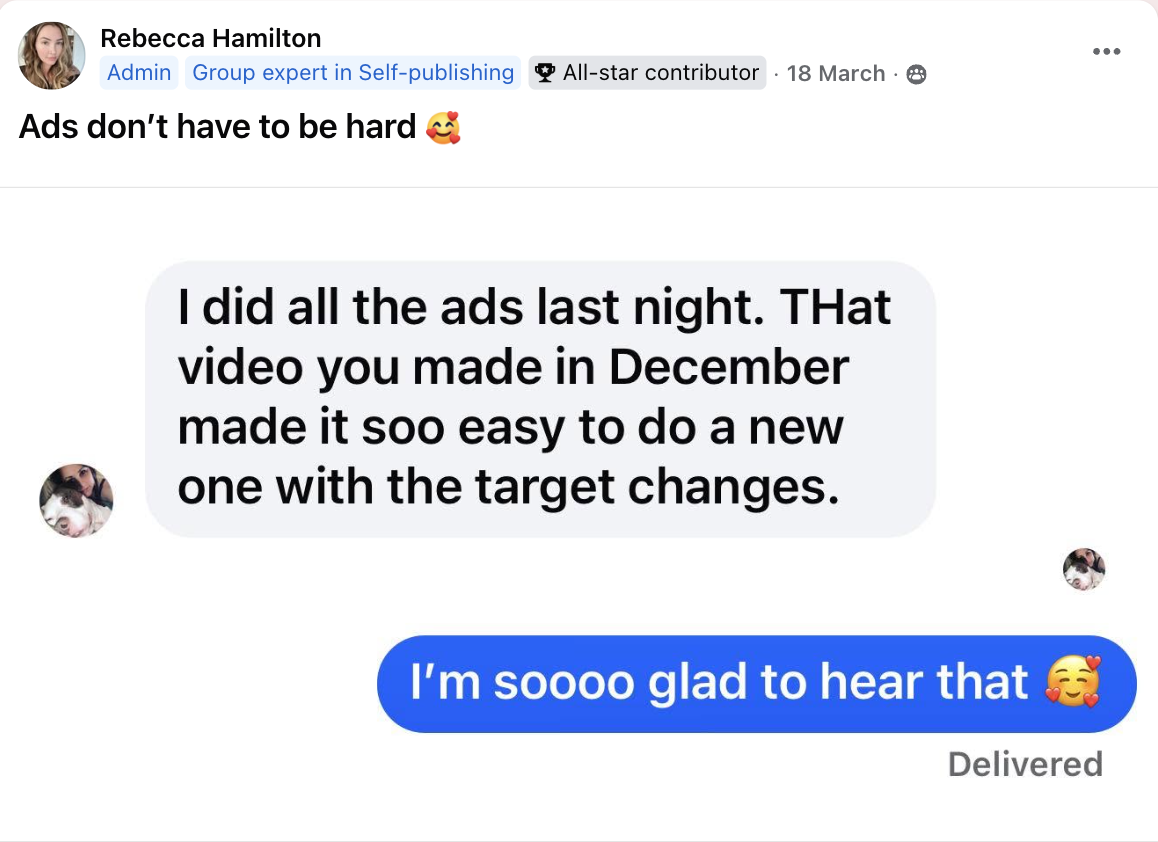
This is the core argument behind what actually scales in author marketing versus what keeps authors stuck, and it is the reason authors inside the program consistently find themselves making more money while doing significantly less than they were doing before.
What Rebecca Hamilton's Author Coaching Results Actually Look Like
The reason Rebecca can make the claims she makes is not confidence. It is pattern visibility across hundreds of authors and genres over more than a decade.
When her focus was on her own writing career, she hit the New York Times, USA Today, and Wall Street Journal bestseller lists, landed an agent, sold film rights to her debut novel, had $40,000 royalty months, and secured publishing deals for translated editions with top publishers.
When she shifted focus to other authors, the results scaled outward. Over 550 authors got their letters, hitting national bestseller lists with Rebecca playing a direct role. She has had a hand in roughly 20% of the top 100 authors across multiple genres. Authors began crossing into seven figures per year. Six-figure annual income became something she could guarantee, provided the strategy was followed precisely.
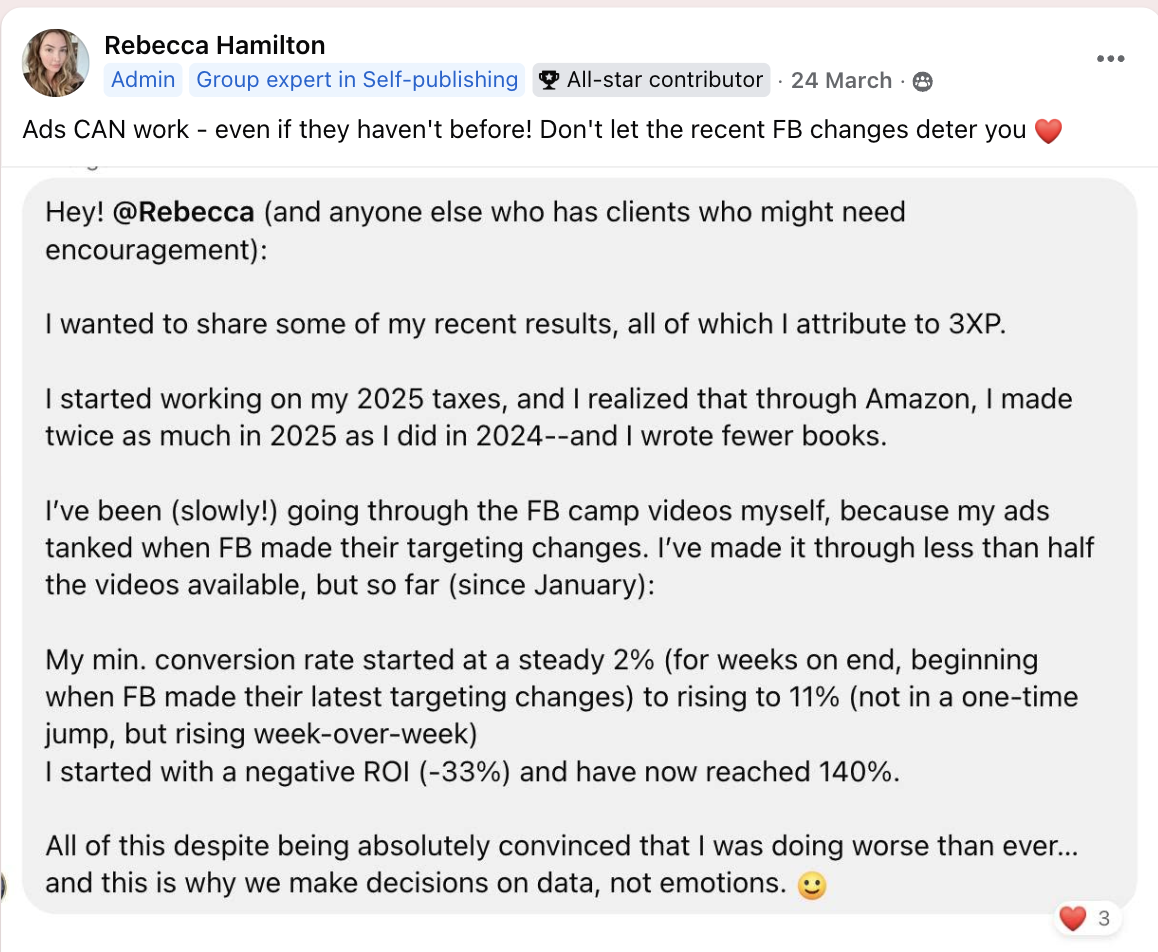
The authors inside the program come from every corner of fiction. Here is what some of them have shared:
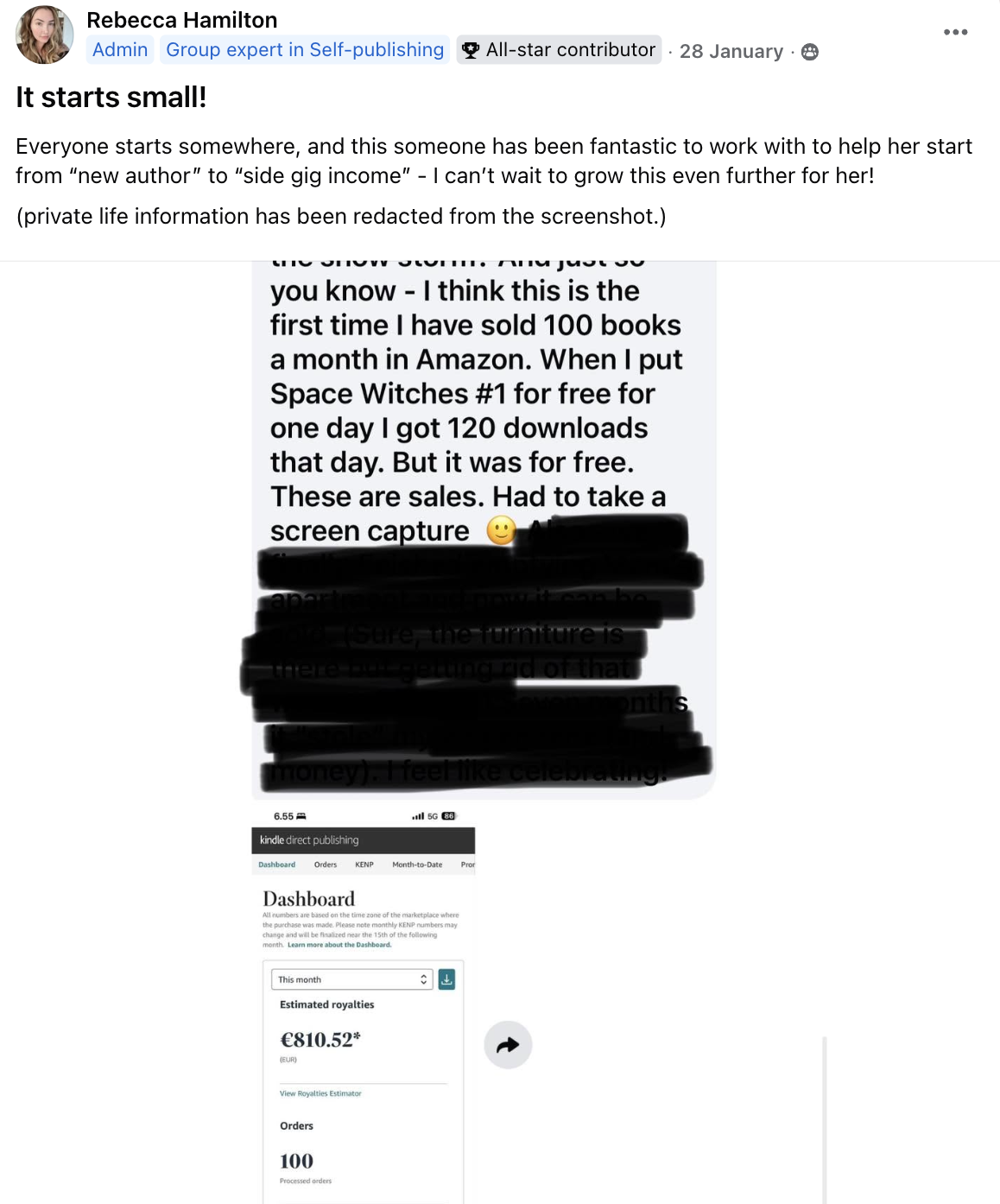
A new author in the Space Witches series celebrated hitting 100 paid sales in a single month for the first time, with €810 in estimated royalties on her KDP dashboard. Rebecca's response: this is truly only the tip of the iceberg.
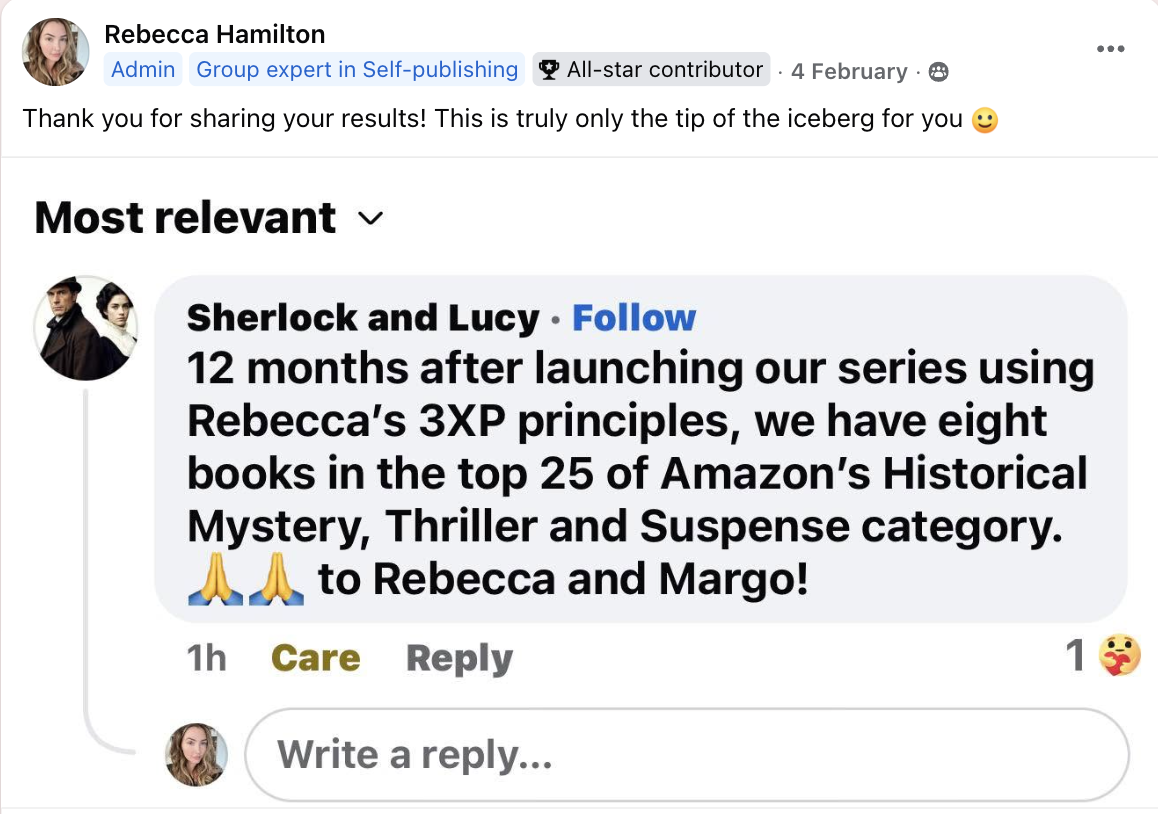
Sherlock and Lucy, writing historical mystery, reported that 12 months after launching their series using Rebecca's 3XP principles, they had eight books sitting in the top 25 of Amazon's Historical Mystery, Thriller and Suspense category.
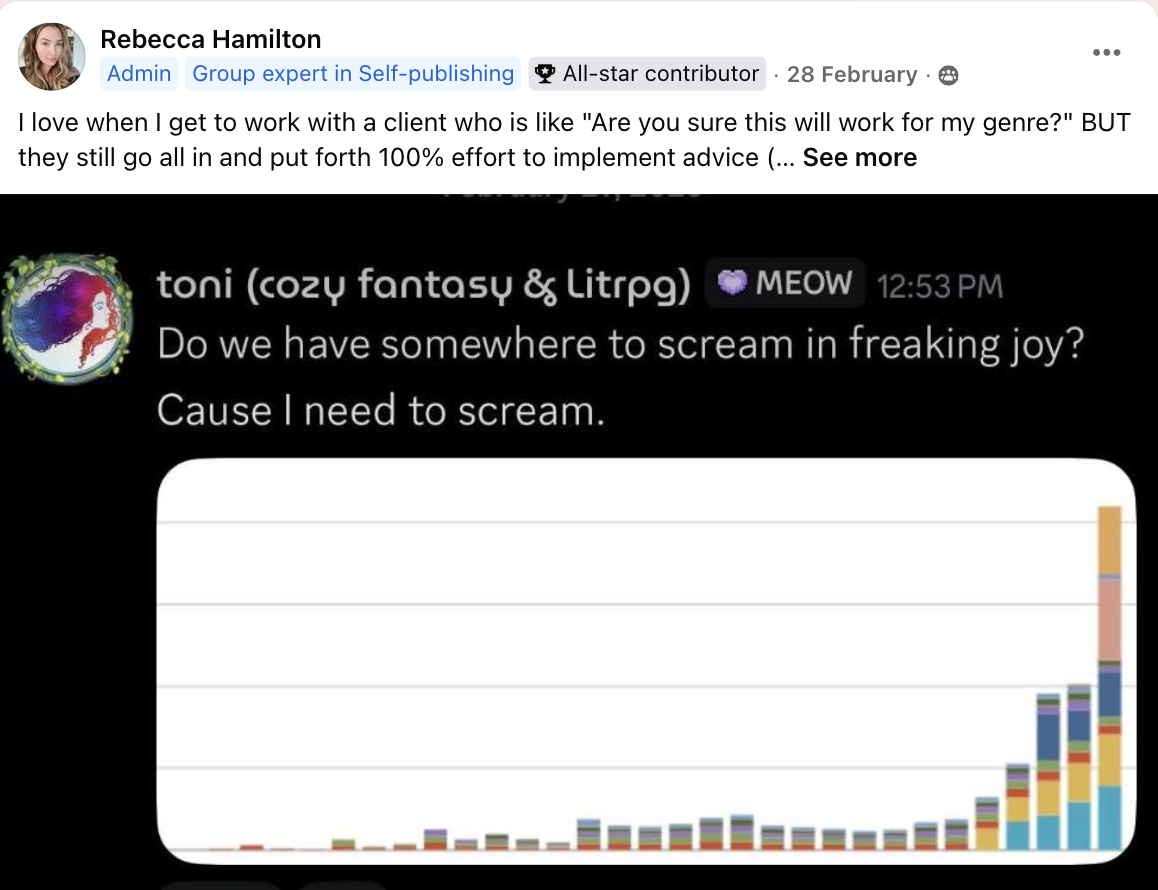
Toni, writing cozy fantasy and LitRPG, shared a royalties chart inside the community showing a dramatic upward curve after implementing the system, alongside a message that read: do we have somewhere to scream in freaking joy? Because I need to scream.
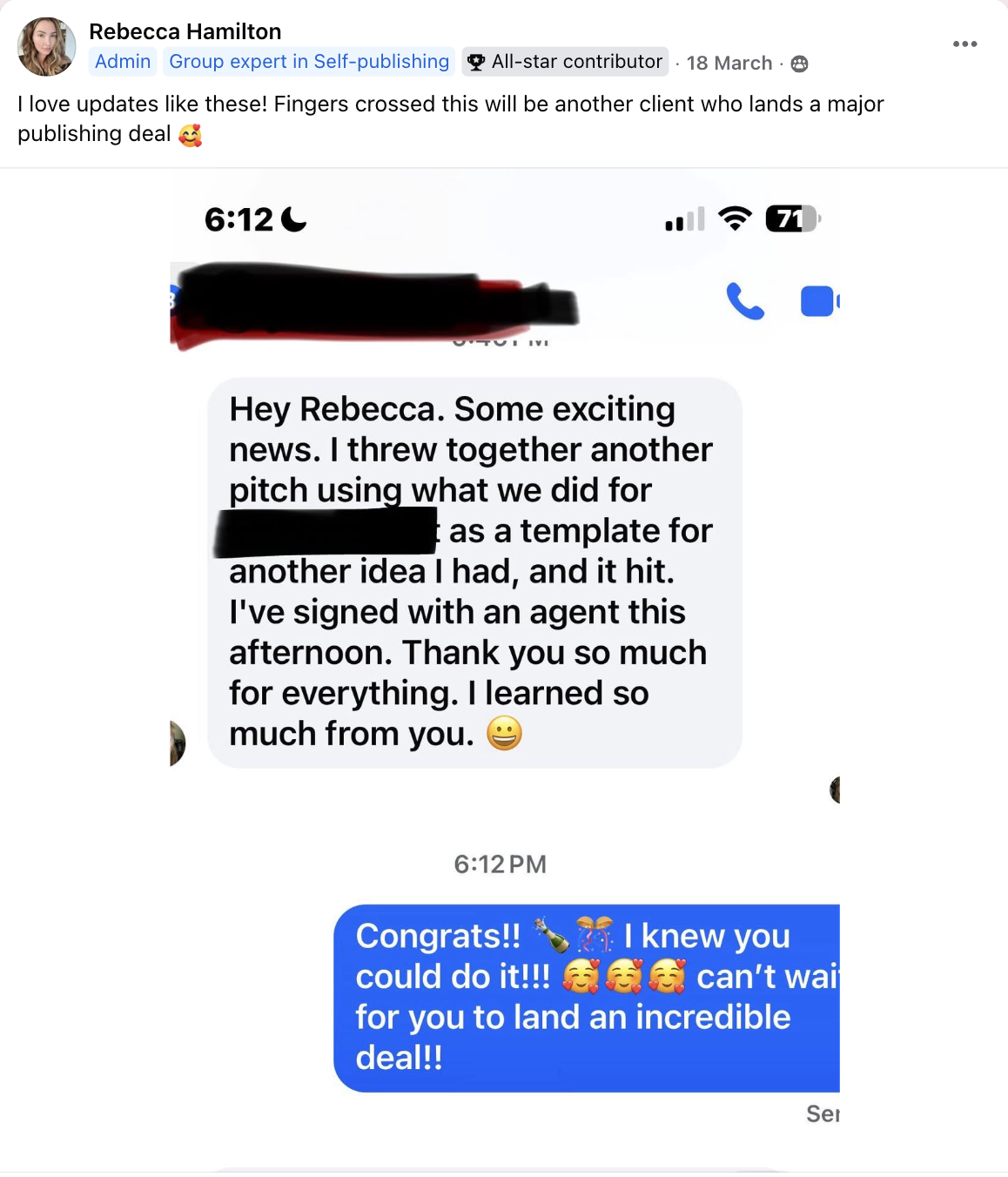
One author signed with an agent the same afternoon she used a pitch template Rebecca helped her build, messaging Rebecca directly: I've signed with an agent this afternoon. Thank you so much for everything. I learned so much from you.
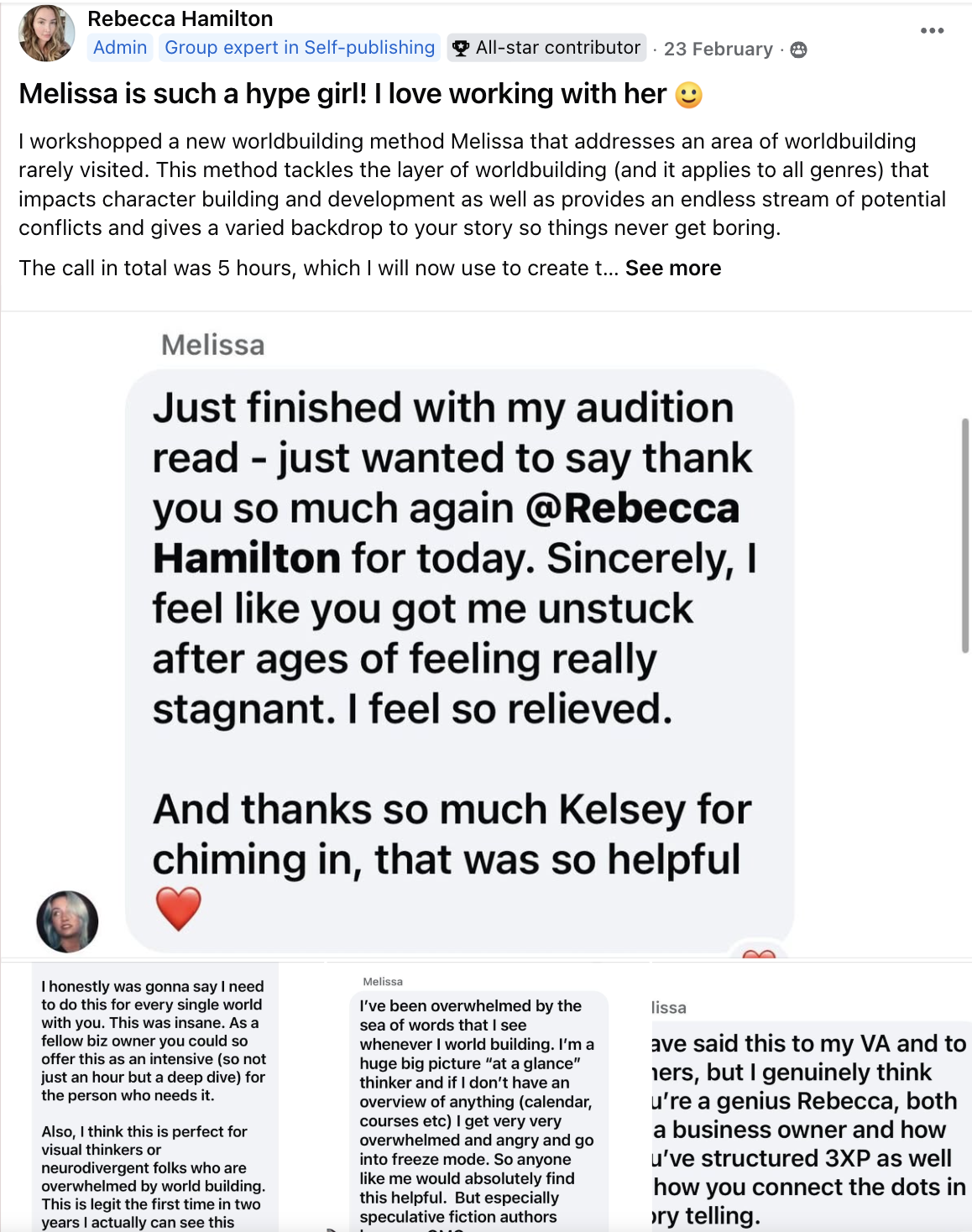
Melissa, after a session working through a new worldbuilding method with Rebecca, sent a message that read: I feel like you got me unstuck after ages of feeling really stagnant. I feel so relieved.
These results span genre fiction, traditional publishing, self-publishing, advertising, and craft. For a fuller picture, the Seven Figure Author Career success stories page has case studies across genres and income levels.
Who Rebecca Hamilton's Fiction Author Coaching Is Actually Built For
Rebecca is specific about who she works with, and that specificity is intentional.
Fiction authors writing for adults, new adults, or young adults who are open to feedback, willing to implement what the data says needs to be done, and approaching their career as a business rather than a hobby. Authors who can set aside what they think they know and work with what the facts actually show.
She does not work with non-fiction authors, children's book authors, or middle grade authors. Not because those careers are less valid, but because her results are proven in specific spaces, and she would rather be precise about where she can really help than make promises she cannot back up. This is the same principle covered in why Rebecca Hamilton's fiction author coaching works for some authors and not others.
She is also clear about who she is not right for: authors who are unwilling to learn something the data says they need to know, authors who cannot approach the work collaboratively, and authors treating publishing purely as a hobby who are not yet ready to invest at the level a serious career requires.
If the finances are not there yet, free resources are available. How to become a successful author starting from zero is a practical starting point for authors who are building toward being ready rather than already there!
Why Data and Patterns Matter More Than Credentials in Author Coaching
Rebecca's approach to author coaching was not built on studying under the right people. The mentors she had in the early part of her career, in the marketing and advertising space specifically, failed her. She is still grateful for it, because it sent her to trial and error and forced her to build her own methods from the data up.
Her grandfather, who was deaf and taught her to read before she was four using closed captions, gave her a dictionary and taught her long division before second grade. Her fourth and fifth grade teacher did not punish her for not conforming. Her sixth grade teacher did not give her detention for questioning everything or finding better ways of doing things.
Those influences are why, when traditional book marketing advice did not work, she did not hesitate to find another way that did.
The result is a framework built on pattern analysis across thousands of data points, hundreds of authors, and more than a decade of testing. When authors hit a royalty ceiling inside the Six Figure Author Coach community, Rebecca can identify exactly why and exactly how to fix it, often while doing significantly less than they were doing before. This pattern visibility is also what she explores in depth in why so many fiction authors work hard and still don't scale.
The Real Question Every Fiction Author Should Ask Before Hiring a Book Marketing Coach
Before investing in any author service, course, coaching program, or tool, the question worth asking is not "does this person offer what I think I need?" It is "does this person understand my career well enough to know what I actually need, and can they show me what happens when authors follow their advice?"
Service providers are valuable. But if what is missing is strategy, a service will not fill that gap.
The difference between authors who plateau and authors who scale is rarely effort. It is almost always the quality of the strategy underneath the effort. And understanding what separates a publishing career from a publishing habit is often the first real step toward closing that gap.
If you are ready to find out whether the Seven Figure Author Career program is the right fit, the next step is applying for a free strategy call where Rebecca's team looks at where your career is, what is holding it back, and whether working together makes sense.
Want More of This?
Rebecca Hamilton is a New York Times, USA Today, and Wall Street Journal bestselling author and coach who has helped hundreds of fiction authors build careers that actually scale. Join the free Six Figure Fiction Facebook group where Rebecca shares live trainings, case studies, and practical advice for building a six or seven figure author career.