

Why Publishing More Books Will Not Break Your Royalty Ceiling
There is a pattern that shows up across almost every fiction author who hits a certain income level and then stops growing.
They are writing. They are publishing. They might even be running ads. And yet the royalties stay roughly the same month after month, year after year, regardless of how many new books they release. Some of them are making $20k a year. Some are making $200k. The number is different but the experience is identical: the income has a ceiling and nothing they do seems to break through it.
Author coach Rebecca Hamilton has worked with hundreds of fiction authors at exactly this point in their careers, and the royalty ceiling problem is one of the most consistent patterns she has documented across genres and career stages. This post covers why it happens, what is actually causing it, and what breaking through it looks like when the right systems are in place.
Why Fiction Authors Hit a Royalty Ceiling in the First Place
The royalty ceiling is not a talent problem. It is almost never a work ethic problem. The authors who hit it are usually working extremely hard. They are producing books consistently, they are trying different marketing approaches, and they are doing everything the advice they have found says to do.
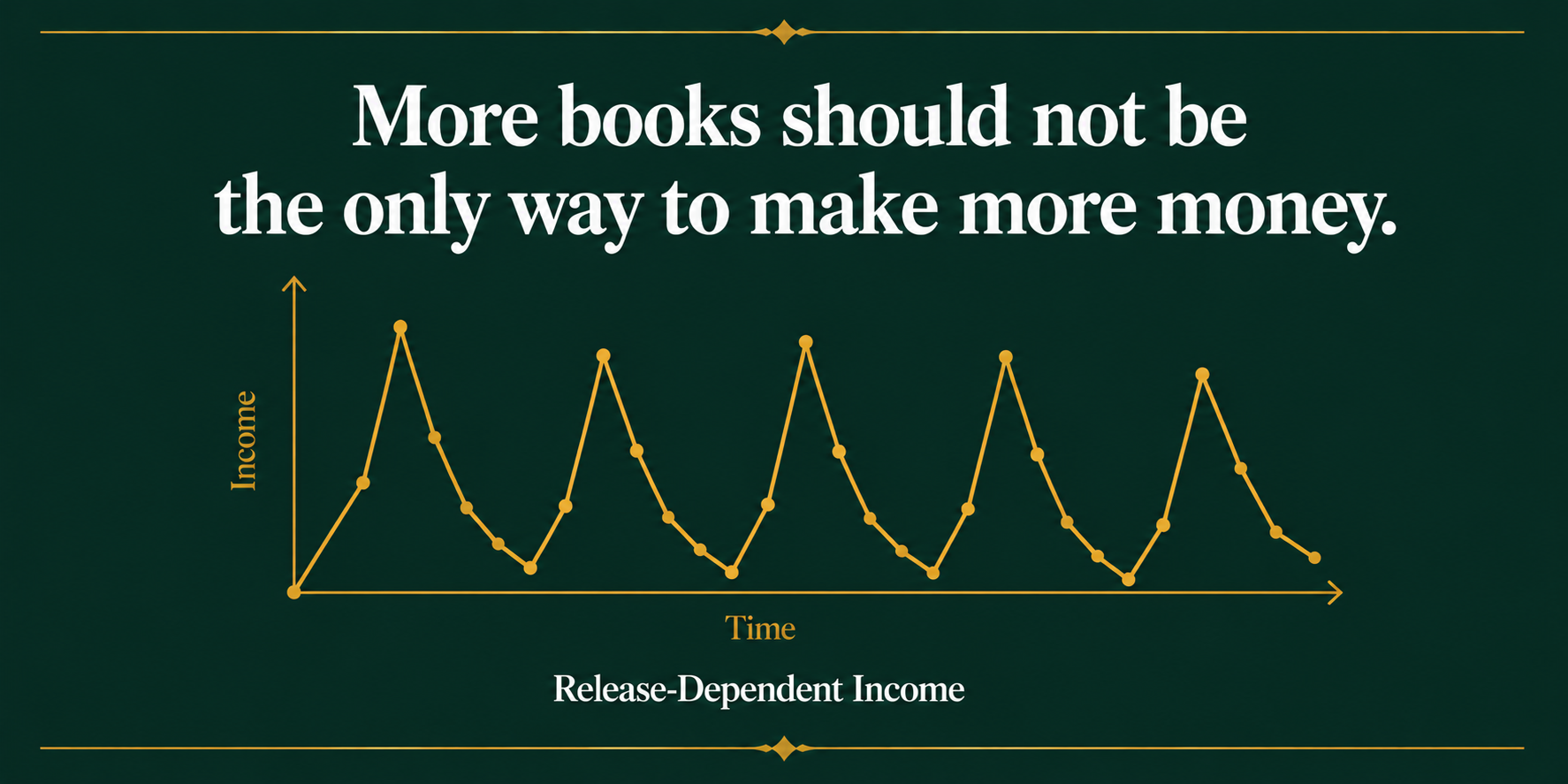
The ceiling exists because of how most fiction authors build their income. Each new release produces a spike in royalties, which then declines as the launch window closes and the next release cycle begins. The pattern creates a situation where income is always tied directly to output. Write more books, make more money. Stop writing, watch the royalties fall.
That sounds like a reasonable business model until you try to scale it. You can only write so many books. You can only launch so many times a year. And if every dollar of royalty income requires a corresponding unit of time and effort to produce, there is a hard ceiling on how much income the model can generate regardless of how much you optimize any individual element.
This is not what royalties are supposed to be. Royalties are passive income by design. A book written years ago should still be generating revenue today without requiring anything additional from the author. When they are not, it is a system problem, not a catalog problem.
Why you have done everything right and your book sales still don't reflect it covers the broader version of this problem, and why most fiction authors work hard and still don't scale addresses the mindset piece that keeps most authors stuck in the output-dependent model long after they realize it is not working.
What the Royalty Ceiling Actually Reveals
The ceiling is not a signal that the author has reached their limit. It is a signal that the infrastructure underneath the catalog is not set up to compound.
Most authors at the royalty ceiling have a catalog that functions like a collection of separate products rather than a connected ecosystem. Each book lives on its own. Readers who buy one book may or may not find the others. Backlist titles generate some organic traffic through Amazon's algorithm but nothing systematic. The catalog is passive in the sense that it exists, but not in the sense that it is actively generating compounding income without ongoing promotion.
When the catalog is built as an ecosystem instead, the behavior changes. Front list releases drive readers into the backlist. Backlist sales create organic signals that drive discovery of front list titles. New readers entering at any point in the catalog are pulled through the full series by the structure of the books themselves rather than by promotion.
This ecosystem is what the 3xP System is built to create, and it is the structural difference between authors who plateau at a certain income level and authors whose royalties continue growing even when they are not actively publishing.
Understanding reader psychology is foundational here because the ecosystem depends on readers being pulled through the catalog by the reading experience itself. A reader who finishes book one and immediately wants book two does not need to be marketed to. The book did the work. That reader also generates algorithm signals, reviews, and word-of-mouth that bring in new readers without additional ad spend.
The Multiplication Effect vs Linear Growth
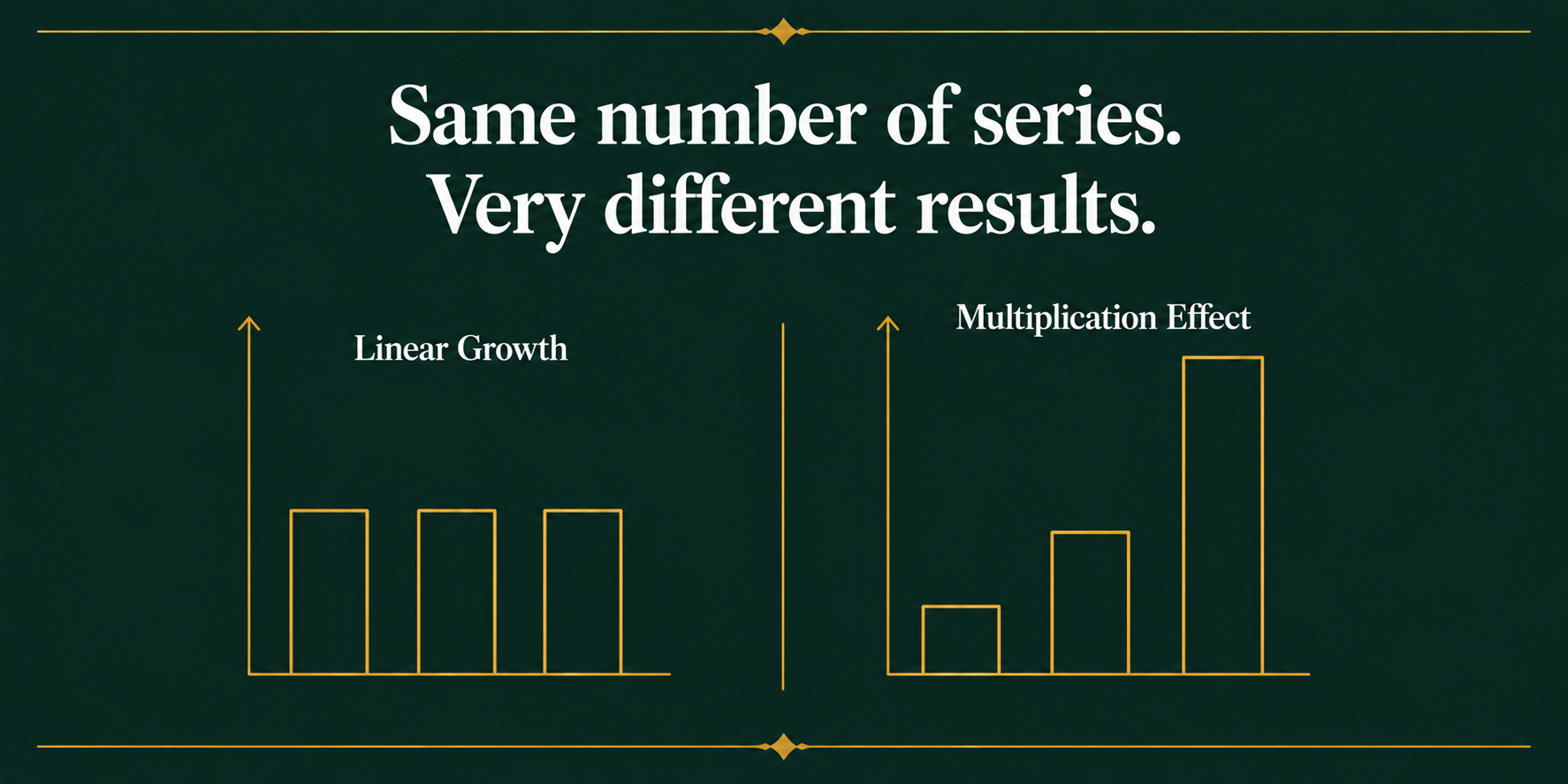
Most authors understand their royalty growth as additive. A second series adds income to the first. A third series adds more. The total grows but the growth is linear, and it is dependent on continuous output to maintain.
The multiplication effect works differently. Instead of each new series adding a fixed increment, each new series multiplies the value of everything already in the catalog. The mechanism behind this is the catalog ecosystem: when front list and backlist are connected correctly, new releases do not just generate their own income. They increase the income being generated by everything else.
Here is what that looks like in practice using the numbers Rebecca teaches inside the program:
With standard linear growth: one series makes $100k. Two series makes $200k. Three series makes $300k.
With the multiplication effect: one series makes $100k. Two series makes $400k. Three series makes $900k.
The difference is not because the second and third series are dramatically better books. It is because the ecosystem underneath is set up so that each series amplifies the others rather than simply existing alongside them.
This is also why what actually scales in author marketing is so different from what most authors are doing. The authors inside the program who break through the ceiling are not necessarily the ones who publish the most or spend the most on ads. They are the ones whose catalog infrastructure is built to compound.
Why More Ad Spend Does Not Break the Ceiling
A common response to stalled royalties is to increase ad spend. The logic makes sense on the surface: if ads are bringing in readers, more ads should bring in more readers and more income.
The problem is that ads can only amplify what is already there. If the catalog ecosystem is not set up to retain readers, more ad spend sends more readers into a leaky bucket. The income from those readers does not compound. It shows up once, in the period immediately after the ad runs, and then disappears.
This is one of the reasons scaling Facebook ads produces diminishing returns for authors who have not addressed the catalog structure first. The ROI drops not because the ads are performing worse but because the infrastructure is not set up to retain the value the ads are creating. More spend does not solve a retention problem. It makes it more expensive.
How book ad metrics actually work covers how sell through rates and lifetime reader value interact with ad performance, and why authors who have low sell through will consistently see poor ad ROI regardless of how well their targeting is set up. The metrics are pointing at the same ceiling problem, just from the ad account side rather than the royalty report side.
The ceiling does not break by spending more. It breaks by fixing the infrastructure that determines what each reader is worth over their full lifetime in the catalog.
What Breaking Through the Ceiling Actually Requires
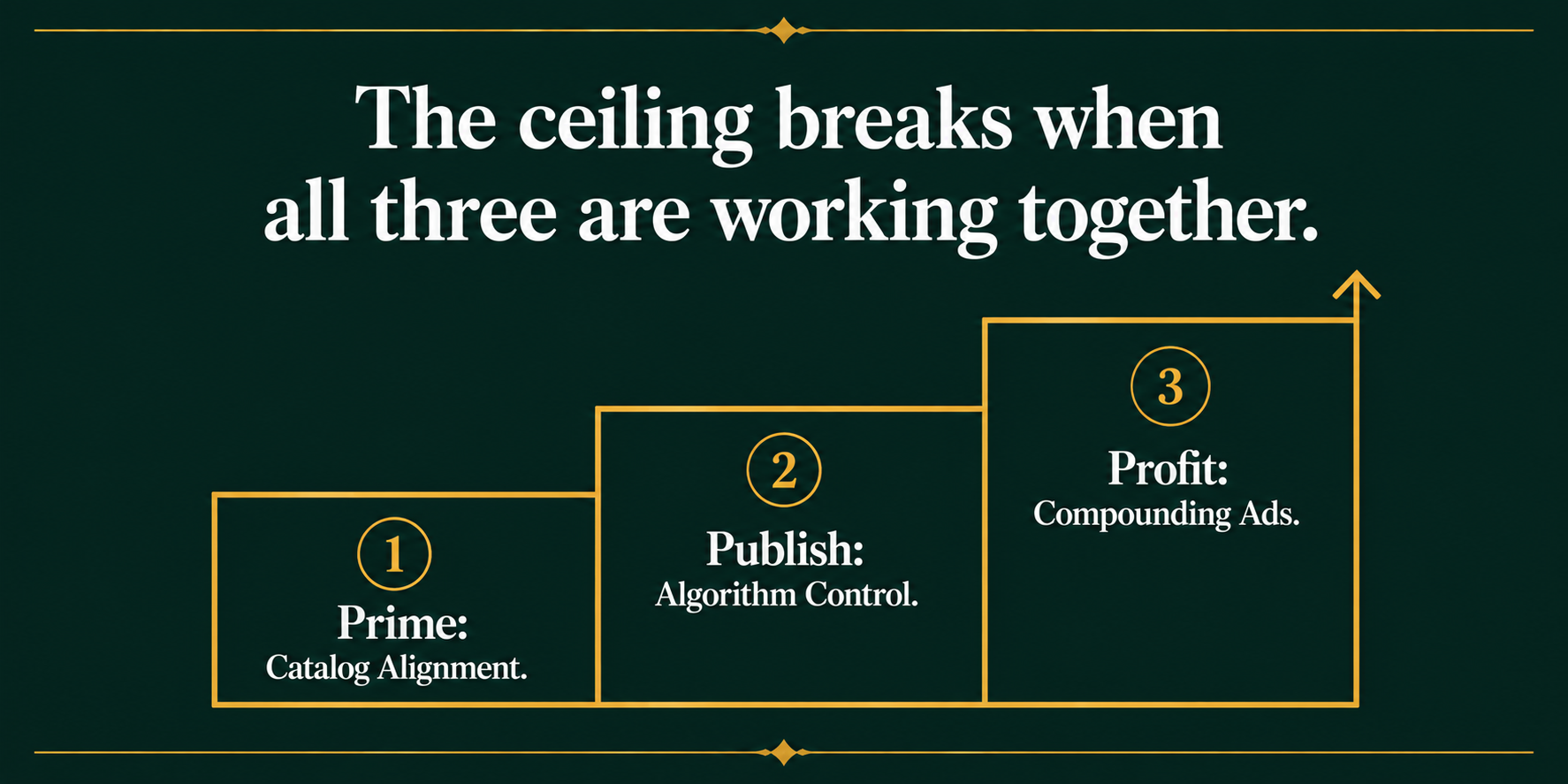
The ceiling breaks when three things change simultaneously: the catalog ecosystem is built to retain readers, the launch and relaunch strategy is built to compound the catalog's organic visibility, and the advertising strategy is built on top of a system that knows what each reader is worth.
The Prime pillar of the 3xP System handles the market research and catalog alignment that makes retention possible. Market research for fiction authors covers why knowing who the actual reader is, rather than who the author assumes the reader is, determines everything downstream. An author who has been writing for the wrong reader, or marketing the right books to the wrong audience, will hit the ceiling faster and harder than one who has that alignment in place from the start.
The Publish pillar handles the launch and relaunch strategy that drives organic visibility. Book launches and how to trigger Amazon's algorithm the right way covers the mechanics of this, and the book launch checklist covers the sequence of what needs to be in place before launch day for the algorithm window to be used correctly. Authors who have been launching without this foundation are consistently leaving the most valuable 90 days of every book's life on the table.
The Profit pillar handles the advertising strategy, but only after the first two pillars are in place. Why most authors think their Facebook ads are broken when they are not is almost always a Prime or Publish pillar problem showing up in the ad metrics. The ceiling does not break by running better ads on top of a broken ecosystem.
The New Release Treadmill and How to Get Off It
One of the clearest signs of a royalty ceiling problem is what Rebecca calls the new release treadmill: the situation where an author's income is entirely dependent on continuous publication and drops the moment they stop releasing.
This is not a sustainable model. An author who has to publish every month to maintain their income does not have a passive royalty stream. They have a job that requires continuous output to keep paying. And any interruption, whether from life circumstances, burnout, a difficult book, or a creative block, results in an immediate income drop.
Breaking the treadmill does not mean stopping publication. It means building the infrastructure so that the catalog is generating compounding income independently of the release schedule. The hard truth about selling books most authors do not want to hear is that the treadmill is a structural problem, not a marketing problem, and marketing harder on top of it only increases the speed of the treadmill rather than removing it.
The five marketability questions are a practical first step for understanding whether the current catalog is positioned to compound. And what most author coaches won't tell you about the ceiling is that solving it requires addressing the structure of the business, not just the tactics on top of it.
What Authors Inside the Program Experience
The pattern Rebecca sees consistently among authors who break through the ceiling inside the program is not that they suddenly started working harder. It is that the work they were already doing started producing compounding results instead of linear ones.
Authors who were making $50k a year and stuck there begin to see their backlist generate income they were not actively promoting. Authors who were on the new release treadmill begin to see months where their income holds or grows without a new release driving it. Authors who were spending heavily on ads begin to see their cost per acquired reader drop as the ecosystem underneath the ads starts doing more of the work.
The Six Figure Author Coach case studies page has specific examples across genres and income levels, including authors who came into the program already at multiple six figures and needed to solve the ceiling problem rather than the starting-from-zero problem.
Finding Out If the Ceiling Is a System Problem
For authors who recognize the royalty ceiling pattern in their own careers, the first step is understanding whether the issue is in the catalog structure, the launch strategy, the ad infrastructure, or some combination of all three.
The free call with Rebecca's team at Seven Figure Author Career is where that diagnosis happens. The team looks at the current catalog, the royalty data, and the marketing approach and identifies specifically where the ceiling is being created and what the fastest path to breaking through it looks like.
Applications are open at sevenfigureauthorcareer.com. For authors who want to get a feel for the community and the approach before applying, the free Six Figure Fiction Facebook group is where Rebecca shares ongoing training on exactly these topics.
Rebecca Hamilton is a New York Times, USA Today, and Wall Street Journal bestselling author as well as the ONLY Author Career Coach to help hundreds of authors hit national bestseller lists and make six to seven figures a year writing fiction. Her proprietary Reader Cloning System removes the guesswork and gets authors from where they are to where they want to be, as quickly as they wish to get there.
